
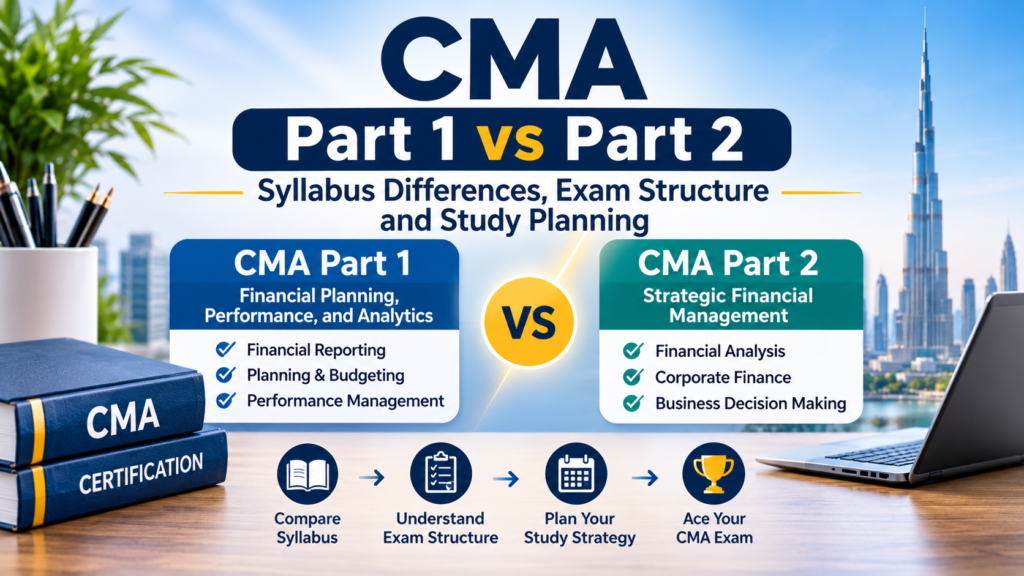
The Certified Management Accountant (CMA) qualification is designed for professionals who want to develop expertise in management accounting, financial planning, performance management, and strategic financial decision-making. Offered by the Institute of Management Accountants (IMA), the US CMA qualification consists of two examination parts: CMA Part 1 and CMA Part 2.
Although both exams are essential for completing the CMA examination requirements, they cover different subject areas and assess different professional skills. CMA Part 1 focuses on financial planning, performance, and analytics, while CMA Part 2 concentrates on strategic financial management and business decision-making.
Understanding the differences between CMA Part 1 vs Part 2 can help you choose an appropriate study sequence, organize your preparation, and allocate sufficient time to challenging topics.
In this guide, we compare the CMA Part 1 and Part 2 syllabuses, explain their exam structures, discuss the major topics covered in each part, and provide a practical study plan to help you prepare effectively.
What Is the Difference Between CMA Part 1 and Part 2?
The main difference between the two CMA exam parts is their focus.
CMA Part 1: Financial Planning, Performance, and Analytics focuses on how organizations plan their financial activities, manage costs, measure performance, maintain internal controls, and use data to support business operations.
CMA Part 2: Strategic Financial Management focuses on analyzing financial statements, evaluating financing options, making business decisions, managing risks, assessing investments, and applying professional ethics.
Both parts require a combination of theoretical understanding, numerical problem-solving, and practical application.
CMA Part 1 vs Part 2: Quick Comparison
| Feature | CMA Part 1 | CMA Part 2 |
| Official title | Financial Planning, Performance, and Analytics | Strategic Financial Management |
| Main focus | Planning, budgeting, costing, performance, and controls | Financial analysis, corporate finance, and strategic decisions |
| Major quantitative areas | Budgeting, cost management, variance analysis, and performance measurement | Financial statement analysis, valuation, decision analysis, and investment appraisal |
| Technology and analytics | Dedicated syllabus area | Applied financial analysis and decision-making |
| Risk and controls | Internal controls | Enterprise risk management |
| Ethics | Relevant professional considerations across the syllabus | Dedicated professional ethics section |
| Exam duration | 4 hours | 4 hours |
| Multiple-choice questions | 100 | 100 |
| Second section | Case-based questions under the current standard English exam format | Case-based questions under the current standard English exam format |
Candidates should confirm the applicable exam format and policies in the official CMA
Candidate Handbook before booking their examinations.
CMA Part 1 Syllabus: Financial Planning, Performance, and Analytics
CMA Part 1 develops the knowledge required to plan financial activities, understand business costs, measure organizational performance, and support effective financial control.
The syllabus contains six major content areas.
- External Financial Reporting Decisions — 15%
This section covers the financial reporting concepts that management accountants need to understand when preparing and interpreting financial information.
Key topics include:
- Financial statements and their components.
- Recognition and measurement concepts.
- Revenue recognition principles.
- Asset valuation and accounting treatment.
- Reporting of liabilities and equity.
- Financial statement presentation.
Study tip: Focus on understanding how accounting transactions affect financial statements. Practice identifying the correct accounting treatment and interpreting the impact on reported financial results.
- Planning, Budgeting, and Forecasting — 20%
Planning and budgeting are important functions of management accounting because they help organizations set targets, allocate resources, and evaluate future financial performance.
Key topics include:
- Strategic planning.
- Budgeting concepts and methodologies.
- Operating and financial budgets.
- Forecasting techniques.
- Variance analysis.
- Flexible budgets.
- Regression analysis and other quantitative techniques.
Study tip: Practice preparing budgets, calculating variances, and interpreting the differences between actual and expected performance. Understanding the reasoning behind each calculation is more useful than memorizing formulas alone.
- Performance Management — 20%
Performance management focuses on measuring how effectively an organization achieves its operational and financial objectives.
Key topics include:
- Cost and revenue performance.
- Variance analysis.
- Responsibility accounting.
- Performance measurement systems.
- Key performance indicators.
- Balanced Scorecard concepts.
- Financial and non-financial performance measures.
Study tip: Work through numerical examples involving performance indicators and variance calculations. Learn how management can use the results to identify problems and improve business performance.
- Cost Management — 15%
Cost management examines how organizations identify, classify, allocate, and control costs.
Key topics include:
- Cost behavior and cost classification.
- Job-order and process costing.
- Activity-based costing.
- Overhead allocation.
- Cost-volume-profit analysis.
- Contribution margin.
- Relevant costing.
- Operational efficiency and cost control.
Study tip: Practice questions involving break-even analysis, contribution margins, overhead allocation, and product costing. Pay particular attention to identifying which costs are relevant to a specific management decision.
- Internal Controls — 15%
Internal controls help organizations protect assets, maintain reliable financial information, and manage operational risks.
Key topics include:
- Internal control frameworks.
- Risk assessment.
- Control activities.
- Segregation of duties.
- Information security.
- Internal control limitations.
- Monitoring and evaluating control effectiveness.
Study tip: Learn to identify control weaknesses in business scenarios and recommend suitable corrective measures. Focus on understanding how controls reduce risk rather than simply memorizing definitions.
- Technology and Analytics — 15%
Technology and analytics examine how information systems and analytical methods support business operations and financial decision-making.
Key topics include:
- Information systems.
- Data management and governance.
- Data analytics.
- Data visualization.
- Technology-enabled business processes.
- Analytical tools used to support management decisions.
Study tip: Understand the purpose of different analytical techniques and how organizations use reliable data to improve planning, forecasting, and performance evaluation.
CMA Part 1 Syllabus Weighting
| Content Area | Weighting |
| External Financial Reporting Decisions | 15% |
| Planning, Budgeting, and Forecasting | 20% |
| Performance Management | 20% |
| Cost Management | 15% |
| Internal Controls | 15% |
| Technology and Analytics | 15% |
| Total | 100% |
Planning, Budgeting, and Forecasting and Performance Management each account for 20% of Part 1. These areas deserve appropriate attention in your study schedule, alongside the remaining syllabus topics.
CMA Part 2 Syllabus: Strategic Financial Management
CMA Part 2 focuses on analyzing financial information and using it to make strategic business and investment decisions.
It contains six major content areas.
- Financial Statement Analysis — 20%
Financial statement analysis helps professionals assess an organization’s financial position, profitability, liquidity, and operating performance.
Key topics include:
- Financial ratio analysis.
- Profitability and liquidity measures.
- Solvency analysis.
- Cash flow analysis.
- Comparative financial analysis.
- Financial performance evaluation.
- Accounting effects on financial ratios.
Study tip: Practice calculating and interpreting financial ratios. Rather than stopping at the numerical answer, understand what each ratio indicates about the organization’s financial health.
- Corporate Finance — 20%
Corporate finance examines how organizations obtain financing, manage financial resources, and evaluate financial risks.
Key topics include:
- Sources of business financing.
- Working capital management.
- Cost of capital.
- Capital structure.
- Financial risk and return.
- Financing decisions.
- Time value of money.
- Financial market concepts.
Study tip: Practice time-value-of-money calculations and financing scenarios. Understand how interest rates, financing costs, and risk influence corporate financial decisions.
- Business Decision Analysis — 25%
Business Decision Analysis is the largest content area in CMA Part 2, accounting for 25% of the syllabus.
It focuses on evaluating alternatives and selecting appropriate courses of action based on financial and operational information.
Key topics include:
- Relevant costing.
- Marginal analysis.
- Pricing decisions.
- Make-or-buy decisions.
- Special-order decisions.
- Risk analysis.
- Decision models.
- Expected value and uncertainty.
Study tip: Practice decision-making questions involving multiple alternatives. Identify relevant costs and benefits, eliminate irrelevant information, and explain why one option is financially preferable to another.
- Enterprise Risk Management — 10%
Enterprise risk management examines how organizations identify, evaluate, and manage risks that may affect their objectives.
Key topics include:
- Risk identification and assessment.
- Risk management frameworks.
- Risk response strategies.
- Enterprise-wide risk considerations.
- Business continuity and risk monitoring.
- The relationship between risk and business strategy.
Study tip: Practice identifying the risks in business scenarios and matching them with appropriate risk management responses.
- Capital Investment Decisions — 10%
Capital investment decisions involve evaluating long-term projects and determining whether expected returns justify the initial investment.
Key topics include:
- Net present value (NPV).
- Internal rate of return (IRR).
- Payback period.
- Discounted cash flow.
- Capital budgeting.
- Investment evaluation.
- Project risk and sensitivity analysis.
Study tip: Become comfortable with time-value-of-money calculations. Practice comparing investment alternatives and interpreting what the results mean for the organization.
- Professional Ethics — 15%
Professional ethics examines the principles and responsibilities that guide ethical behavior in management accounting and financial management.
Key topics include:
- Professional integrity.
- Ethical decision-making.
- Conflicts of interest.
- Professional responsibilities.
Study tip: Study the relevant ethical standards and practice applying them to realistic workplace situations. Understand the reasoning behind the appropriate response to an ethical dilemma.
CMA Part 2 Syllabus Weighting
| Content Area | Weighting |
| Financial Statement Analysis | 20% |
| Corporate Finance | 20% |
| Business Decision Analysis | 25% |
| Enterprise Risk Management | 10% |
| Capital Investment Decisions | 10% |
| Professional Ethics | 15% |
| Total | 100% |
Business Decision Analysis accounts for 25% of Part 2, making it the largest individual content area. Financial Statement Analysis and Corporate Finance each contribute another 20%.
Candidates should still study every content area because the weighting alone does not determine which specific questions will appear.
CMA Part 1 vs Part 2: Which Exam Is More Difficult?
There is no universal answer to which CMA exam part is more difficult. The level of difficulty depends on your educational background, work experience, familiarity with accounting concepts, and ability to apply numerical methods.
However, understanding the nature of each syllabus can help you identify the areas where you may need additional preparation.
Why Candidates May Find Part 1 Challenging
Part 1 can be demanding because it covers a wide range of management accounting concepts.
Candidates may need to work through:
- Complex budgeting and forecasting calculations.
- Cost accounting and cost allocation.
- Cost-volume-profit analysis.
- Performance measurement and variance analysis.
- Financial reporting concepts.
- Internal control and technology-related topics.
- Candidates who are less familiar with management accounting may need extra practice with numerical problems.
Why Candidates May Find Part 2 Challenging
Part 2 requires candidates to interpret financial information and evaluate strategic alternatives.
Challenging areas may include:
- Financial ratio interpretation.
- Cost of capital calculations.
- Time-value-of-money problems.
- Capital budgeting techniques.
- Relevant costing and decision analysis.
- Risk assessment and ethical scenarios.
Candidates who have strong knowledge of accounting but limited exposure to corporate finance may need more time to understand investment appraisal and financing decisions.
How to Decide Which Part Needs More Preparation
Consider the following questions:
- Are you comfortable preparing and interpreting budgets?
- Do you understand cost behavior and variance analysis?
- Can you calculate and interpret financial ratios?
- Are you familiar with the time value of money?
- Can you evaluate investment alternatives using NPV and IRR?
- Are you comfortable applying ethical principles to workplace scenarios?
- Your answers can help you identify which areas deserve additional study time.
- Remember that the syllabus weightings and your own strengths should guide your preparation. Do not assume that one exam part will automatically be easier for every candidate.
CMA Exam Structure: What to Expect in Part 1 and Part 2
CMA Part 1 and Part 2 have the same overall examination duration and core structure.
Each part is a four-hour examination consisting of 100 multiple-choice questions and a second section containing two case-based questions under the standard English exam format applicable from the September/October 2026 testing window onward.
The earlier essay format has been replaced by case-based questions for English exams in the Middle East and other specified regions. Candidates testing in China, Japan, and Taiwan may have different format provisions under IMA policies.
Examination Structure
| Exam Component | Details |
| Examination duration | 4 hours |
| Multiple-choice questions | 100 questions |
| Time for multiple-choice section | 3 hours |
| Second section | Two case-based questions |
| Time for second section | 1 hour |
| Total examination time | 4 hours |
The examination format is the same for both parts, but the accounting and financial management concepts tested are different.
What Are CMA Case-Based Questions?
Case-based questions present a business scenario followed by questions that assess your ability to apply the concepts you have studied.
Depending on the case, you may be required to complete calculations, select appropriate responses, fill in missing information, or interpret financial data.
For example, a Part 1 case may involve a budgeting or performance management scenario, while a Part 2 case may involve financial analysis or a business decision.
These questions assess practical application rather than simple recall.
Candidates should practice with current study materials that reflect the case-based format and consult the latest CMA Candidate Handbook for the rules applicable to their examination.
Should You Take CMA Part 1 or Part 2 First?
One advantage of the CMA programme is that candidates can take Part 1 and Part 2 in either order.
You do not have to pass Part 1 before registering for Part 2.
The best sequence depends on your existing knowledge, learning preferences, and professional background.
- Consider Taking Part 1 First If:
You want to begin with budgeting, cost management, and performance measurement.
You have a strong interest in management accounting.
You prefer to build your preparation around operational and financial planning concepts.
You want to establish a foundation before moving to broader strategic finance topics.
- Consider Taking Part 2 First If:
You already have a strong background in financial statement analysis.
You are comfortable with corporate finance and investment appraisal.
Your current work involves financial analysis or strategic decision-making.
You prefer to begin with topics that align closely with your existing experience.
Can You Study Both Parts Together?
You can study both parts during the same overall preparation period, but it is important to avoid spreading your attention too thinly.
Some candidates prefer to concentrate on one exam part, complete the revision, and then move to the second. Others may study selected topics from both parts before focusing on one examination date.
Choose an approach that allows sufficient time for practice questions, case-based scenarios, and final revision.
How to Plan Your CMA Part 1 and Part 2 Studies
A structured study plan can help you cover the syllabus systematically while allowing time to review difficult concepts.
Your preparation schedule should consider your work commitments, prior accounting knowledge, and target examination date.
- Step 1: Assess Your Existing Knowledge
Begin by reviewing the syllabus for the part you intend to take.
Identify topics you already understand and those that require more attention.
For Part 1, assess your knowledge of budgeting, cost accounting, variance analysis, and internal controls.
For Part 2, evaluate your understanding of financial statement analysis, corporate finance, decision analysis, and investment appraisal.
- Step 2: Allocate Study Time by Topic
Use the official syllabus weightings as one factor when deciding how to divide your time.
For example, Business Decision Analysis deserves substantial attention in Part 2 because it accounts for 25% of that examination’s content.
Likewise, Planning, Budgeting, and Forecasting and Performance Management each account for 20% of Part 1.
However, allocate additional time to topics that you personally find difficult, even if they have a lower weighting.
- Step 3: Practise Questions After Every Topic
After completing a chapter, answer practice questions covering the material you have studied.
Review both correct and incorrect answers.
When you make a mistake, identify whether it resulted from a calculation error, misunderstanding of a concept, or misinterpretation of the question.
This helps you correct weaknesses before moving to the next topic.
- Step 4: Practice Case-Based Questions Early
Do not wait until the final week to practice case-based questions.
Begin with simple scenarios and gradually progress to more complex questions.
Practice extracting relevant information, performing calculations, and selecting answers within a reasonable time.
- Step 5: Revise and Monitor Your Progress
Schedule regular revision sessions instead of relying on one final review.
Use practice results to decide which topics need additional work.
As the examination approaches, complete timed practice sessions and review your recurring mistakes.
A Practical Eight-Week CMA Study Plan
The following is an illustrative eight-week plan for preparing for one CMA exam part. It assumes you have already established a basic understanding of the subject and can study consistently.
| Week | Main Activity | Study Focus |
| Week 1 | Foundation building | Review the syllabus and establish a study schedule |
| Week 2 | Core topic preparation | Study major syllabus areas and practise topic-based questions |
| Week 3 | Concept development | Continue syllabus coverage and review difficult concepts |
| Week 4 | Numerical practice | Focus on calculations, formulas, and applied questions |
| Week 5 | Remaining topics | Complete syllabus coverage and identify knowledge gaps |
| Week 6 | Practice and revision | Work through mixed multiple-choice questions and case-based scenarios |
| Week 7 | Exam preparation | Complete timed practice tests and revise weak areas |
| Week 8 | Final review | Review key concepts, practise exam-style questions, and refine time management |
This plan is a starting point rather than a guaranteed preparation timeline. Candidates with limited prior knowledge may require a longer period, while experienced professionals may adjust the schedule to suit their needs.
If you are preparing for both parts, plan a separate study cycle for each examination and allow time for final revision before each test.
Common Mistakes to Avoid When Preparing for CMA Exams
- Treating Both Syllabuses as Identical
Although both parts share a focus on financial decision-making, their content areas differ.
What to do instead: Use the official syllabus for each part and organize your revision accordingly.
- Memorizing Formulas Without Understanding Them
Memorization alone may not help when questions require you to interpret results or apply calculations to unfamiliar scenarios.
What to do instead: Understand what each formula measures and practice using it in different situations.
- Ignoring Lower-Weighting Topics
Candidates sometimes focus exclusively on the largest syllabus areas.
What to do instead: Prioritize important topics without neglecting the rest of the syllabus.
- Practicing Only Multiple-Choice Questions
Multiple-choice practice is important, but it does not fully prepare you for the case-based section.
What to do instead: Include both multiple-choice questions and case-based scenarios in your regular preparation.
- Leaving Revision Until the End
Studying new topics until the last few days can leave insufficient time to identify and correct weaknesses.
What to do instead: Build revision into your schedule from the beginning.
Frequently Asked Questions About CMA Part 1 and Part 2
- What is the main difference between CMA Part 1 and Part 2?
CMA Part 1 focuses on financial planning, performance, cost management, internal controls, and analytics. CMA Part 2 focuses on financial statement analysis, corporate finance, business decision analysis, risk management, investment decisions, and ethics.
- Is CMA Part 1 harder than Part 2?
Difficulty depends on your background and strengths. Candidates who are comfortable with budgeting and cost accounting may prefer Part 1, while those with strong financial analysis and corporate finance knowledge may find Part 2 more familiar.
- Can I take CMA Part 2 before Part 1?
Yes. IMA allows candidates to take the two examination parts in either order. You should select the sequence that best matches your preparation and examination plans.
- How long is each CMA exam?
Each CMA examination part lasts four hours. Under the standard English exam format applicable from the September/October 2026 testing window onward, each part contains 100 multiple-choice questions and two case-based questions.
- Has the CMA exam format changed in 2026?
Yes. For English CMA exams in the Middle East and other specified regions, case-based questions became the standard format from the September/October 2026 testing window onward, replacing the previous essay format. Candidates should consult the current CMA Candidate Handbook for applicable regional provisions.
- How much time should I spend preparing for each CMA part?
The preparation time depends on your existing knowledge, available study hours, and familiarity with the syllabus. A structured schedule should include syllabus coverage, practice questions, case-based scenarios, and final revision.
- Which CMA Part 2 topic has the highest weighting?
Business Decision Analysis has the highest individual weighting in Part 2 at 25%. Financial Statement Analysis and Corporate Finance each account for 20%.
- Which CMA Part 1 topics have the highest weighting?
Planning, Budgeting, and Forecasting and Performance Management each account for 20% of Part 1.
- Do I need to complete both CMA exam parts?
Yes. Passing both Part 1 and Part 2 is required to complete the CMA examination component of the certification programme. Candidates must also satisfy the applicable education, experience, and other programme requirements.
Prepare for Your CMA Journey with Emerge Management Training Center
Understanding the differences between CMA Part 1 and Part 2 is an important first step towards planning your examination preparation.
Whether you are focusing on budgeting and performance management or developing your knowledge of financial analysis and strategic decision-making, a structured study approach can help you work through the syllabus more effectively.
At Emerge Management Training Center, you can explore CMA training options designed to support your professional accounting and finance goals.
If you are looking for CMA training in Dubai, consider a preparation programme that provides structured syllabus coverage, practice questions, guidance on challenging topics, and support with exam preparation.
Take the next step towards strengthening your management accounting knowledge and preparing for the CMA qualification.
Contact Emerge Management Training Center to learn more about upcoming CMA batches and course details.
Website: www.emerge.pro
Email: enq@emerge.pro
Phone: +971 4 352 1133
Mobile: +971 50 457 7375
Conclusion
CMA Part 1 and Part 2 are designed to develop complementary skills in management accounting and strategic financial management.
Part 1 emphasizes planning, budgeting, cost management, performance measurement, internal controls, and analytics. Part 2 concentrates on financial statement analysis, corporate finance, decision analysis, risk management, capital investment decisions, and professional ethics.
Understanding these differences helps you identify your strengths, select an appropriate exam sequence, and create a study plan that reflects the demands of each syllabus.
By combining systematic learning, regular practice, case-based question preparation, and targeted revision, you can approach both CMA examinations with a clearer plan and greater confidence.
Start by reviewing the official syllabus, assessing your current knowledge, and setting realistic study targets for your first examination.