
Understanding revenue recognition is essential for accountants, auditors, and finance professionals working with International Financial Reporting Standards (IFRS). Among these standards, IFRS 15 – Revenue from Contracts with Customers plays a crucial role in determining when and how businesses should recognise revenue.
Whether you are strengthening your accounting knowledge, preparing for professional development, or exploring IFRS training in Dubai, understanding the five-step revenue recognition model can help you develop practical financial reporting skills.
In this guide, we explain the five steps of IFRS 15 with practical business examples, covering customer contracts, performance obligations, transaction prices, revenue allocation, and revenue recognition.
For professionals seeking practical IFRS coaching, these examples provide a useful starting point for understanding how the standard applies to different business transactions. They are also valuable for learners exploring IFRS certification in Dubai and looking to strengthen their knowledge of international accounting standards.
- What Is IFRS 15 Revenue Recognition?
IFRS 15 is an International Financial Reporting Standard that establishes the principles an entity must apply when reporting revenue from contracts with customers.
The standard provides a comprehensive framework for determining:
- When revenue should be recognised.
- How much revenue should be recognised.
- Whether revenue should be recognised over time or at a point in time.
- How to account for contracts containing multiple goods or services.
- How to deal with discounts, incentives, refunds, and variable consideration.
The central principle of IFRS 15 is that an entity should recognise revenue to depict the transfer of promised goods or services to customers in an amount that reflects the consideration the entity expects to receive in exchange.
In simple terms, revenue is recognised when a business transfers control of promised goods or services to a customer, rather than simply when payment is received.
For example, a company may receive an advance payment in December for services it will provide in January and February. The receipt of cash does not automatically mean that the entire amount can be recognised as revenue in December.
Instead, revenue recognition depends on the contract terms and when the company satisfies its performance obligations.
- Why Is IFRS 15
IFRS 15 plays an important role in improving the consistency, transparency, and comparability of financial reporting.
The standard helps businesses determine the appropriate treatment of different customer transactions and provides a structured approach to revenue recognition.
Its importance extends across several industries, including:
- Construction and real estate.
- Retail and wholesale.
- Information technology.
- Professional consulting.
- Education and training.
- Manufacturing and distribution.
For accountants and auditors, understanding IFRS 15 is particularly important when reviewing customer contracts, evaluating revenue transactions, and preparing financial statements.
Professionals pursuing IFRS training in Dubai can benefit from understanding how these requirements apply to different industries and business situations.
Understanding the IFRS 15 Five-Step Model
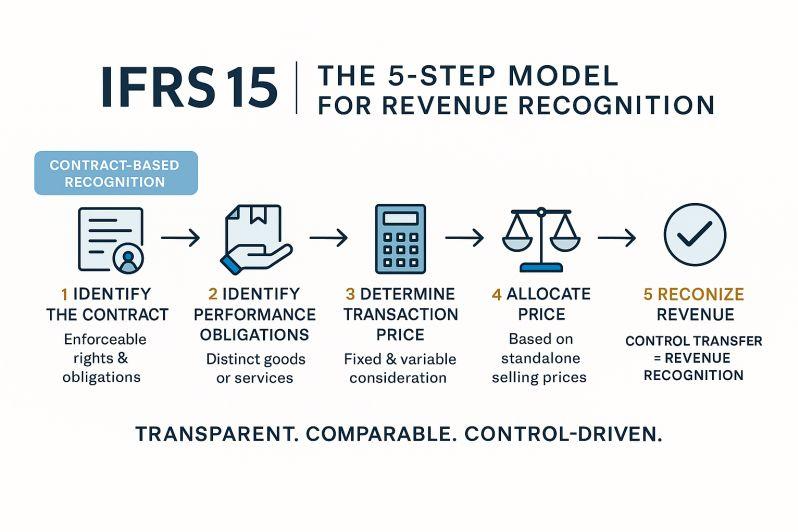
IFRS 15 follows a five-step model to determine how and when revenue should be recognised.
The five steps are:
- Identify the contract with the customer.
- Identify the performance obligations in the contract.
- Determine the transaction price.
- Allocate the transaction price to the performance obligations.
- Recognise revenue when or as the entity satisfies a performance obligation.
Each step builds on the previous one. Let’s examine each step with practical examples.
Step 1: Identify the Contract with the Customer
The first step is to identify a contract with a customer that meets the requirements of IFRS 15.
A contract may be written, oral, or implied by an entity’s customary business practices, provided the applicable criteria are satisfied.
Under IFRS 15, a contract generally qualifies when:
The parties have approved the contract and are committed to performing their respective obligations.
Each party’s rights regarding the goods or services to be transferred can be identified.
The payment terms can be identified.
The contract has commercial substance.
It is probable that the entity will collect the consideration to which it expects to be entitled in exchange for the goods or services.
Example: Identifying a Customer Contract
ABC Electronics enters into an agreement with a corporate customer to supply 100 laptops for AED 200,000.
The agreement specifies the products, delivery terms, and payment conditions. Both parties approve the agreement, and the arrangement meets the contract criteria under IFRS 15.
In this situation, ABC Electronics identifies the agreement as a contract with a customer.
However, if an arrangement does not meet the contract criteria, the entity cannot automatically recognise revenue under IFRS 15 simply because it has received a payment.
Key takeaway: Before recognizing revenue, an entity must establish that an arrangement qualifies as a contract under IFRS 15.
Step 2: Identify the Performance Obligations in the Contract
A performance obligation is a promise in a contract to transfer a distinct good or service, or a distinct bundle of goods or services, to a customer.
A good or service is generally distinct when:
The customer can benefit from it on its own or together with other readily available resources.
The promise to transfer the good or service is separately identifiable from other promises in the contract.
A single contract may contain one performance obligation or several performance obligations.
Example: A Laptop and a Maintenance Service
ABC Electronics enters into a contract to provide a customer with:
One laptop.
Twelve months of technical support and maintenance.
The total contract price is AED 5,000.
Assume the laptop and maintenance service are distinct and separately identifiable.
The company identifies two performance obligations:
Delivery of the laptop.
Provision of technical support and maintenance for twelve months.
The company must then determine how much of the contract price relates to each performance obligation.
The laptop revenue may be recognised when control transfers to the customer, while the maintenance revenue will generally be recognised over the service period as the service is provided.
Key takeaway: A contract containing multiple promised goods or services may require separate performance obligations and different revenue recognition patterns.
Step 3: Determine the Transaction Price
The transaction price is the amount of consideration an entity expects to be entitled to in exchange for transferring promised goods or services to a customer.
When determining the transaction price, an entity may need to consider:
- Fixed payments.
- Variable consideration.
- Discounts and rebates.
- Refunds and incentives.
- Significant financing components.
- Non-cash consideration.
- Consideration payable to a customer.
Variable consideration may arise when a contract includes performance bonuses, penalties, discounts, or other amounts that depend on future events.
IFRS 15 requires entities to estimate variable consideration using either the expected value method or the most likely amount method, depending on which method better predicts the amount of consideration.
The estimate is subject to the variable consideration constraint. An entity includes estimated variable consideration only to the extent that it is highly probable that a significant reversal of cumulative revenue will not occur when the uncertainty is resolved.
Example: Contract with a Performance Bonus
A consulting company enters into a contract to provide services for a fixed fee of AED 100,000.
The contract also provides for a performance bonus of AED 20,000 if the project is completed by an agreed deadline.
The maximum possible consideration is AED 120,000.
However, the company cannot automatically recognise the maximum possible amount of AED 120,000.
It must estimate the variable consideration and apply the constraint to determine whether the bonus can be included in the transaction price.
If the estimated bonus meets the requirements for inclusion, the transaction price may include the eligible bonus. Otherwise, it may initially be limited to the fixed fee of AED 100,000.
Key takeaway: The transaction price reflects the consideration the business expects to be entitled to, subject to the specific requirements of IFRS 15.
Step 4: Allocate the Transaction Price to the Performance Obligations
When a contract contains more than one performance obligation, the entity generally allocates the transaction price to each performance obligation based on its relative stand-alone selling price.
The stand-alone selling price is the price at which an entity would sell a promised good or service separately to a customer.
If a stand-alone selling price is not directly observable, the entity estimates it using an appropriate method.
Common estimation approaches include:
- Adjusted market assessment approach.
- Expected cost plus a margin approach.
- Residual approach, where the conditions for using it are met.
Example: Allocating the Contract Price
ABC Electronics sells a laptop and a twelve-month maintenance service together for AED 5,000.
Assume their stand-alone selling prices are:
Item Stand-alone selling price
Laptop AED 4,500
Maintenance service AED 1,500
Total AED 6,000
The customer receives a package discount because the combined contract price is AED 5,000 rather than AED 6,000.
The company allocates the transaction price based on the relative stand-alone selling prices.
Allocation for the laptop:
AED 5,000 × (AED 4,500 ÷ AED 6,000) = AED 3,750
Allocation for the maintenance service:
AED 5,000 × (AED 1,500 ÷ AED 6,000) = AED 1,250
The allocation is therefore:
Performance obligation Allocated transaction price
Laptop AED 3,750
Maintenance service AED 1,250
Total AED 5,000
The company would generally recognise the AED 3,750 allocated to the laptop when control transfers to the customer.
The AED 1,250 allocated to maintenance would generally be recognised over the twelve-month service period, assuming the service is provided evenly throughout that period.
Key takeaway: The transaction price is generally allocated based on relative stand-alone selling prices, not simply according to management’s preference.
Step 5: Recognise Revenue When or as the Performance Obligation Is Satisfied
The final step is to recognise revenue when, or as, the entity satisfies a performance obligation by transferring control of the promised good or service to the customer.
IFRS 15 distinguishes between revenue recognised over time and revenue recognised at a point in time.
- Revenue Recognised Over Time
Revenue is recognised over time when one of the criteria in IFRS 15 is met.
These criteria include situations where:
The customer simultaneously receives and consumes the benefits as the entity performs.
The entity’s performance creates or enhances an asset that the customer controls as the asset is created or enhanced.
The entity’s performance does not create an asset with an alternative use to the entity, and the entity has an enforceable right to payment for performance completed to date.
When a performance obligation is satisfied over time, revenue is recognised by measuring progress towards complete satisfaction of that obligation using an appropriate method.
Example: Monthly Accounting Services
A firm agrees to provide accounting services to a client for AED 12,000 over twelve months.
Assuming the services are provided evenly throughout the contract period and the relevant over-time criteria are met, the firm recognises AED 1,000 in revenue each month.
Calculation:
AED 12,000 ÷ 12 months = AED 1,000 per month.
The revenue is recognised as the accounting services are provided, rather than entirely when the contract is signed or the payment is received.
- Revenue Recognised at a Point in Time
If a performance obligation does not qualify for recognition over time, revenue is recognised at the point in time when control of the good or service transfers to the customer.
Indicators that control may have transferred include:
- The entity has a present right to payment.
- The customer has legal title to the asset.
- The customer has physical possession of the asset.
- The customer has the significant risks and rewards of ownership.
- The customer has accepted the asset.
- These indicators must be considered in the context of the contract. No single indicator automatically determines the outcome in every case.
Example: Sale of Office Furniture
A furniture company sells office desks to a corporate customer for AED 30,000.
The contract meets the requirements for revenue recognition, and control of the desks transfers to the customer upon delivery and acceptance under the agreed terms.
If the performance obligation is satisfied at that point, the company recognises AED 30,000 in revenue when control transfers.
Receiving payment before delivery would not, by itself, justify recognizing revenue before the performance obligation is satisfied.
Key takeaway: Revenue recognition depends on when control of the promised goods or services transfers to the customer, not merely on when cash is received.
Comprehensive Example: Applying All Five Steps of IFRS 15
Let’s apply the complete five-step model to a practical business scenario.
Scenario
A training company enters into a contract with a corporate customer for AED 24,000.
The package includes:
A professional training programme.
Twelve months of access to an online learning platform.
Assume the two services are distinct, the contract satisfies the requirements of IFRS 15, and the training and platform access meet the relevant criteria for revenue recognition over time.
The stand-alone selling prices are:
Service Stand-alone selling price
Training programme AED 18,000
Online learning platform AED 12,000
Total AED 30,000
The company offers both services together for AED 24,000.
Applying the Five Steps
Step 1: Identify the contract
The training company identifies the approved corporate agreement as a contract with a customer because the applicable IFRS 15 contract criteria are met.
Step 2: Identify the performance obligations
The company identifies two distinct performance obligations: the training programme and the online learning platform access.
Step 3: Determine the transaction price
The transaction price is AED 24,000, assuming there is no variable consideration or other adjustment.
Step 4: Allocate the transaction price
The transaction price is allocated using relative stand-alone selling prices.
Training programme:
AED 24,000 × (AED 18,000 ÷ AED 30,000) = AED 14,400.
Online learning platform:
AED 24,000 × (AED 12,000 ÷ AED 30,000) = AED 9,600.
Step 5: Recognise revenue
Assume the training programme is delivered evenly over three months and qualifies for over-time recognition.
The company recognises AED 4,800 per month during those three months:
AED 14,400 ÷ 3 months = AED 4,800 per month.
Assume the online learning platform provides a stand-ready service evenly over twelve months and also qualifies for over-time recognition.
The company recognises AED 800 per month over twelve months:
AED 9,600 ÷ 12 months = AED 800 per month.
During the first three months, assuming both services are provided as described, the company recognises total revenue of AED 5,600 per month.
After the training programme is completed, the company continues recognising AED 800 per month for the remaining nine months of platform access.
This example demonstrates how the five-step model helps an entity allocate revenue to separate performance obligations and recognise it according to the pattern in which the promised services are provided.
Note: The revenue recognition pattern in an actual contract depends on the specific contractual terms and the requirements of IFRS 15.
Common IFRS 15 Revenue Recognition Mistakes
Even experienced accounting professionals may encounter challenges when applying IFRS 15.
Some common mistakes include:
- Recognizing revenue when cash is received
Cash receipts and revenue recognition are not necessarily simultaneous. Advance payments may create a contract liability until the related goods or services are transferred.
- Treating every contract as one performance obligation
A contract may contain several distinct goods or services that require separate accounting treatment.
- Ignoring variable consideration
Bonuses, penalties, rebates, and discounts may affect the transaction price and must be evaluated under the standard.
- Allocating revenue incorrectly
Where multiple performance obligations exist, the transaction price is generally allocated using relative stand-alone selling prices.
- Confusing point-in-time and over-time recognition
Revenue must be recognised according to the applicable control-transfer requirements and the nature of the performance obligation.
- Overlooking disclosure requirements
IFRS 15 includes disclosure requirements relating to revenue, contract balances, performance obligations, and significant judgements. Accurate reporting requires more than calculating the revenue amount.
Understanding these areas is important for preparing reliable financial statements and avoiding errors during audits.
Who Should Understand IFRS 15?
A practical understanding of IFRS 15 is valuable for:
Accountants and finance executives.
External and internal auditors.
Financial controllers.
Finance managers.
Financial reporting specialists.
Accounting students preparing for professional qualifications.
Professionals working in consulting, construction, technology, retail, and service industries.
Because revenue recognition can involve significant judgement, professionals benefit from studying the standard through practical scenarios rather than memorizing definitions alone.
Frequently Asked Questions About IFRS 15
- What are the five steps of IFRS 15?
The five steps are identifying the contract, identifying the performance obligations, determining the transaction price, allocating the transaction price, and recognizing revenue when or as performance obligations are satisfied.
- When should revenue be recognised under IFRS 15?
Revenue is recognised when or as an entity satisfies a performance obligation by transferring control of a promised good or service to a customer.
- What is a performance obligation?
A performance obligation is a promise in a customer contract to transfer a distinct good or service, or a distinct bundle of goods or services.
- What is the difference between point-in-time and over-time revenue recognition?
Point-in-time recognition applies when control transfers at a specific point. Over-time recognition applies when one of the criteria specified in IFRS 15 is met, with revenue recognised according to progress in satisfying the performance obligation.
- How is the transaction price allocated under IFRS 15?
When a contract contains multiple performance obligations, the transaction price is generally allocated according to the relative stand-alone selling prices of the promised goods or services, subject to the standard’s specific requirements and exceptions.
- Does receiving an advance payment mean revenue can be recognised immediately?
No. An advance payment does not automatically qualify as revenue. Depending on the circumstances, the amount may be recognised as a contract liability until the related performance obligation is satisfied.
- Why is IFRS 15 important for accounting professionals?
IFRS 15 helps accounting professionals determine when and how much revenue to recognise, apply appropriate judgement to complex contracts, and prepare financial statements that comply with applicable reporting requirements.
Develop Your Professional Knowledge with IFRS Training in Dubai
A strong understanding of International Financial Reporting Standards is valuable for accounting professionals who want to improve their financial reporting knowledge and apply international accounting standards confidently.
When choosing IFRS training in Dubai, look for a programme that combines technical concepts with practical examples, case studies, and real-world accounting applications.
Quality IFRS coaching can help learners understand complex topics such as:
- Revenue recognition under IFRS 15.
- Lease accounting under IFRS 16.
- Financial instruments under IFRS 9.
- Presentation of financial statements.
- Accounting for assets and liabilities.
- Practical application of international accounting standards.
If you are exploring IFRS certification in Dubai, developing a clear understanding of standards such as IFRS 15 is an important step towards strengthening your professional accounting knowledge.
At Emerge Management Training Center, you can explore IFRS training opportunities designed to support your accounting and finance career.
Whether you are looking to improve your technical knowledge or strengthen your understanding of practical financial reporting, take the next step towards developing your professional expertise.
Get in touch with Emerge Management Training Center to learn more about upcoming IFRS batches and course details.
Website: www.emerge.pro
Email: enq@emerge.pro
Phone: +971 4 352 1133
Mobile: +971 50 457 7375
Conclusion
IFRS 15 provides a structured approach to revenue recognition through its five-step model. By identifying customer contracts, determining performance obligations, calculating the transaction price, allocating consideration, and recognizing revenue as control transfers, businesses can report revenue more consistently and accurately.
For accounting and finance professionals, mastering IFRS 15 is essential for handling customer contracts, preparing financial statements, and understanding complex revenue recognition scenarios.
The best way to develop confidence in IFRS 15 is to combine theoretical knowledge with practical examples, case studies, and real-world accounting applications.
If you are looking for IFRS training in Dubai, practical IFRS coaching, or opportunities to explore IFRS certification in Dubai, Emerge Management Training Center can help you take the next step in your accounting and finance journey.